
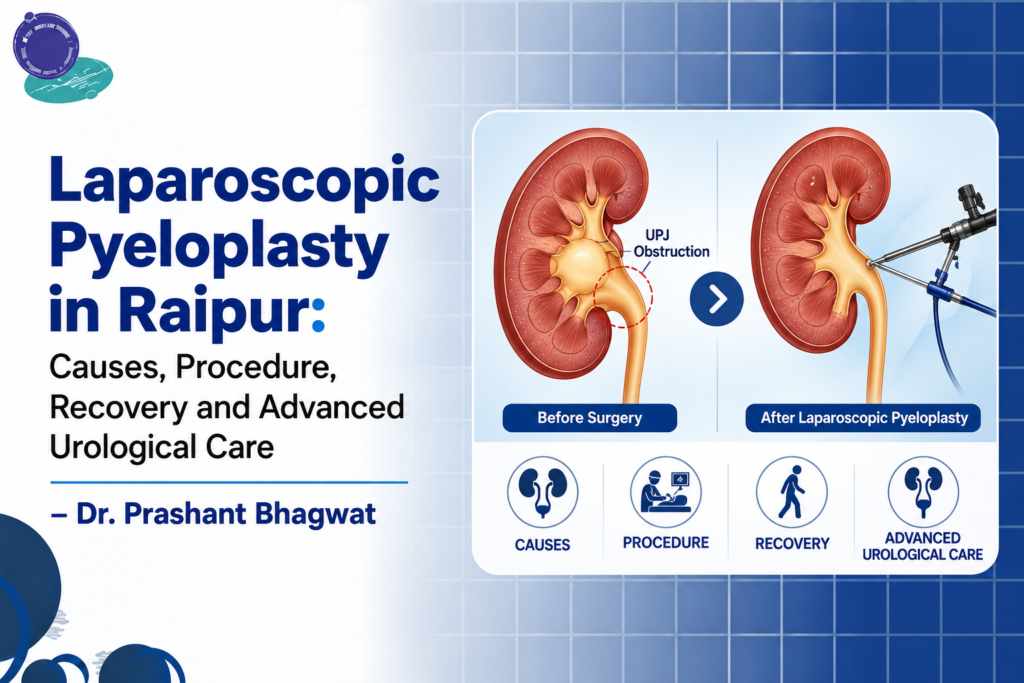
Laparoscopic Pyeloplasty in Raipur: Causes, Procedure, Recovery and Advanced Urological Care by Dr. Prashant Manohar Bhagwat
Laparoscopic Pyeloplasty in Raipur is a minimally invasive surgical procedure used to correct ureteropelvic junction (UPJ) obstruction, a condition that restricts the normal flow of urine from the kidney into the ureter. When urine cannot drain properly, it may accumulate inside the kidney, causing swelling, recurrent infections, flank pain and, in some cases, deterioration of kidney function. Early diagnosis and appropriate treatment can help protect the affected kidney and improve urinary drainage. At Dr. M R Bhagwat Memorial Hospital, patients receive medical and surgical care supported by operation theatres, diagnostic facilities, patient monitoring systems and intensive care infrastructure. The hospital provides a multispecialty environment for evaluating urological conditions and planning appropriate surgical treatment. Dr. Prashant Manohar Bhagwat is an experienced urologist who has been practicing in Raipur since 1999. He completed his MBBS and MS in General Surgery from Pt. J. N. M. Medical College, Raipur, followed by DNB in Urology under the guidance of Dr. C. Nageswara Rao. He further enhanced his clinical experience at K.E.M. Hospital, Pune, and earned the FRCS qualification from Glasgow, Scotland, United Kingdom. His special interests include endoscopic urological procedures, kidney stone management and laparoscopic urological surgery. People searching for Laparoscopic Pyeloplasty in Samta Colony, Raipur may want to understand when surgery is necessary, how the procedure works, and what recovery involves. This guide explains the condition, diagnostic process, available treatment approaches, surgical preparation, postoperative care and important questions patients should discuss with their urologist. What Is Laparoscopic Pyeloplasty? Laparoscopic pyeloplasty is a reconstructive surgical procedure performed to correct a narrowing or blockage at the ureteropelvic junction. This junction connects the renal pelvis, which collects urine inside the kidney, to the ureter, the tube that carries urine to the urinary bladder. When this connection becomes narrowed, urine may not drain efficiently. The resulting pressure can cause swelling of the kidney, known as hydronephrosis. Depending on the severity and duration of the obstruction, patients may experience pain, infections, kidney stones or impaired kidney function. During laparoscopic pyeloplasty, the surgeon uses a camera and specialised instruments inserted through small incisions. The narrowed segment is corrected, and the healthy portions of the urinary tract are reconstructed to improve urine drainage. The exact technique depends on the patient’s anatomy, the location and length of the obstruction, previous procedures and the surgeon’s assessment. A temporary ureteral stent may also be placed to support drainage while the reconstructed area heals. Understanding Ureteropelvic Junction Obstruction UPJ obstruction can be present from birth or develop later in life. In children, it is often associated with the development of the urinary tract. In adults, it may be related to scarring, previous surgery, kidney stones or blood vessels that cross and compress the junction. The severity varies from person to person. Some individuals have mild narrowing that can be monitored, while others develop significant obstruction that affects kidney drainage. For patients considering Laparoscopic Pyeloplasty in Choubey Colony, Raipur, understanding the underlying cause is an important first step. The urologist evaluates whether the narrowing is responsible for the symptoms and whether it is affecting kidney function. Common Causes of UPJ Obstruction Congenital narrowing: Some individuals are born with an abnormality at the connection between the kidney and ureter. Crossing blood vessels: An unusually positioned blood vessel may compress the junction and interfere with urine flow. Scar tissue: Previous surgery, inflammation or injury may contribute to narrowing. Kidney stones: Stones or stone-related changes may contribute to urinary obstruction in selected cases. Changes after previous procedures: Certain interventions involving the urinary tract can sometimes lead to scarring or recurrent narrowing. Identifying the likely cause helps the urologist select the most appropriate treatment. Common Symptoms of UPJ Obstruction UPJ obstruction does not always cause noticeable symptoms. Some cases are discovered during ultrasound examinations performed for unrelated reasons. When symptoms develop, their nature and severity can vary according to the degree of obstruction and the patient’s age. Possible symptoms include: Pain in the side or back near the kidney Recurrent flank discomfort Abdominal pain Nausea or vomiting associated with pain Repeated urinary tract infections Blood in the urine Kidney stones Fever when infection is present Abnormal kidney swelling on imaging People searching for Laparoscopic Pyeloplasty in Shankar Nagar, Raipur may be experiencing recurring discomfort or may have received an ultrasound report showing hydronephrosis. However, these symptoms do not automatically indicate UPJ obstruction. Kidney stones, urinary infections, musculoskeletal problems and other conditions can produce similar complaints. A urological assessment is necessary to determine the underlying cause. When Should Symptoms Be Evaluated? Medical evaluation is appropriate when flank pain keeps returning, urinary infections recur, blood appears in the urine or imaging shows unexplained kidney swelling. Fever with suspected urinary obstruction requires urgent medical assessment because an infected, obstructed urinary system can become serious. Severe pain accompanied by vomiting, reduced urine output or significant weakness also warrants prompt attention. Who May Need Laparoscopic Pyeloplasty? Not every patient diagnosed with UPJ obstruction needs surgery immediately. The decision depends on symptoms, kidney function, the degree of obstruction, imaging findings and the risk of future complications. A urologist may recommend reconstructive surgery when investigations show that the obstruction is clinically significant. Patients With Persistent Pain Repeated flank pain associated with impaired kidney drainage may indicate that the obstruction is affecting daily life and requires treatment. Patients With Recurrent Infections When obstruction contributes to repeated urinary infections, correcting the underlying drainage problem may be considered. Patients With Declining Kidney Function If functional testing shows deterioration in the affected kidney, the urologist may recommend intervention to address the obstruction. Patients With Progressive Hydronephrosis Increasing kidney swelling, especially when accompanied by impaired drainage or declining function, may influence the decision to operate. For patients researching Laparoscopic Pyeloplasty in Civil Lines, Raipur, the important question is not simply whether narrowing is present, but whether it is affecting kidney health enough to justify surgery. Who May Not Need Immediate Surgery? Patients with mild obstruction, stable kidney function and no concerning symptoms may sometimes be monitored instead of undergoing immediate